Published on
Nature is our most important infrastructure and. It's time to invest accordingly
Healthy ecosystems are the foundation of resilient societies, yet they remain chronically underfunded. Using Acción Andina's work across the Andes as an example, we explore why nature should be treated as critical infrastructure, and why long-term, holistic investment is essential to protect it. Co-authored with Isabella Orgel, Managing Director of Communications at Global Forest Generation.


Natalya Yakusheva Jarlebring
Senior Environmental Lead
More than half of global GDP depends on nature. Forests regulate water that feeds agriculture. Wetlands filter drinking water. Mountain ecosystems store and slowly release freshwater. Coastal habitats protect communities from storms. These are not environmental amenities—they are the living infrastructure that makes economies and societies possible.
Yet unlike roads, power grids or hospitals, nature has no maintenance budget.
For generations we've assumed natural systems will simply continue working. But across the Andes, glaciers are retreating, forests are disappearing, and water cycles that sustained communities for centuries are becoming less reliable.
Nature is no longer replenishing itself at the pace we have come to expect, but we treat it as though it needs nothing from us. Natural systems should run as well-oiled as a machine. In fact, they're more complex than any machine we've ever built.
The systems that support us need care, investment, and stewardship.
Nature is infrastructure. And it belongs to all of us.
As climate impacts intensify, nature is becoming one of our greatest sources of resilience.
Healthy ecosystems reduce flood risks, store carbon, secure freshwater supplies, support biodiversity, and strengthen communities against an increasingly uncertain future. Investing in nature is therefore not simply an environmental priority, it's a strategic investment in the long-term stability of our economies and societies.
The challenge is that natural systems rarely fit into conventional funding models. A mountain forest doesn't only store carbon. It protects water supplies, supports biodiversity, sustains indigenous and local livelihoods, and strengthens local economies—all at the same time. Trying to separate these benefits into individual projects often overlooks the way ecosystems actually function.
Nature works as an interconnected whole. Our funding should too.
The Andes show what's at stake
Nowhere is this clearer than in the high Andes.
The bosques altoandinos (montane forest ecosystems), bofedales (high-altitude peatland wetlands) and páramos (humid mountain grasslands) of the Andes form one of the world's most important water systems. Polylepis forests capture moisture from clouds, regulate watersheds, and supply water to millions of people across cities such as Quito, Bogotá and Lima, as well as countless farming communities downstream.
For generations, Indigenous Peoples and local communities have cared for these landscapes with limited resources and little recognition. Today, climate change, land degradation and fire are placing growing pressure on ecosystems that entire regions depend upon.
The consequences are already visible.
"I remember that the water springs used to gush out with strength," says Enaida Trujillo from the Chua Community in Abancay, Peru. "Now those springs have dried up. I would like them to appear again."
Working with Acción Andina partner ICEA, her community is restoring native Polylepis forests, helping improve water retention and bringing degraded landscapes back to life.
Across six Andean countries, Acción Andina has shown what long-term, locally-led restoration can achieve. More than 40,000 people have participated in restoration efforts, over 12.5 million native trees have been planted, and more than 11,000 hectares are now under active protection.
These achievements are possible because restoration is rooted in local leadership, traditional knowledge, and long-term stewardship, not short-term projects.
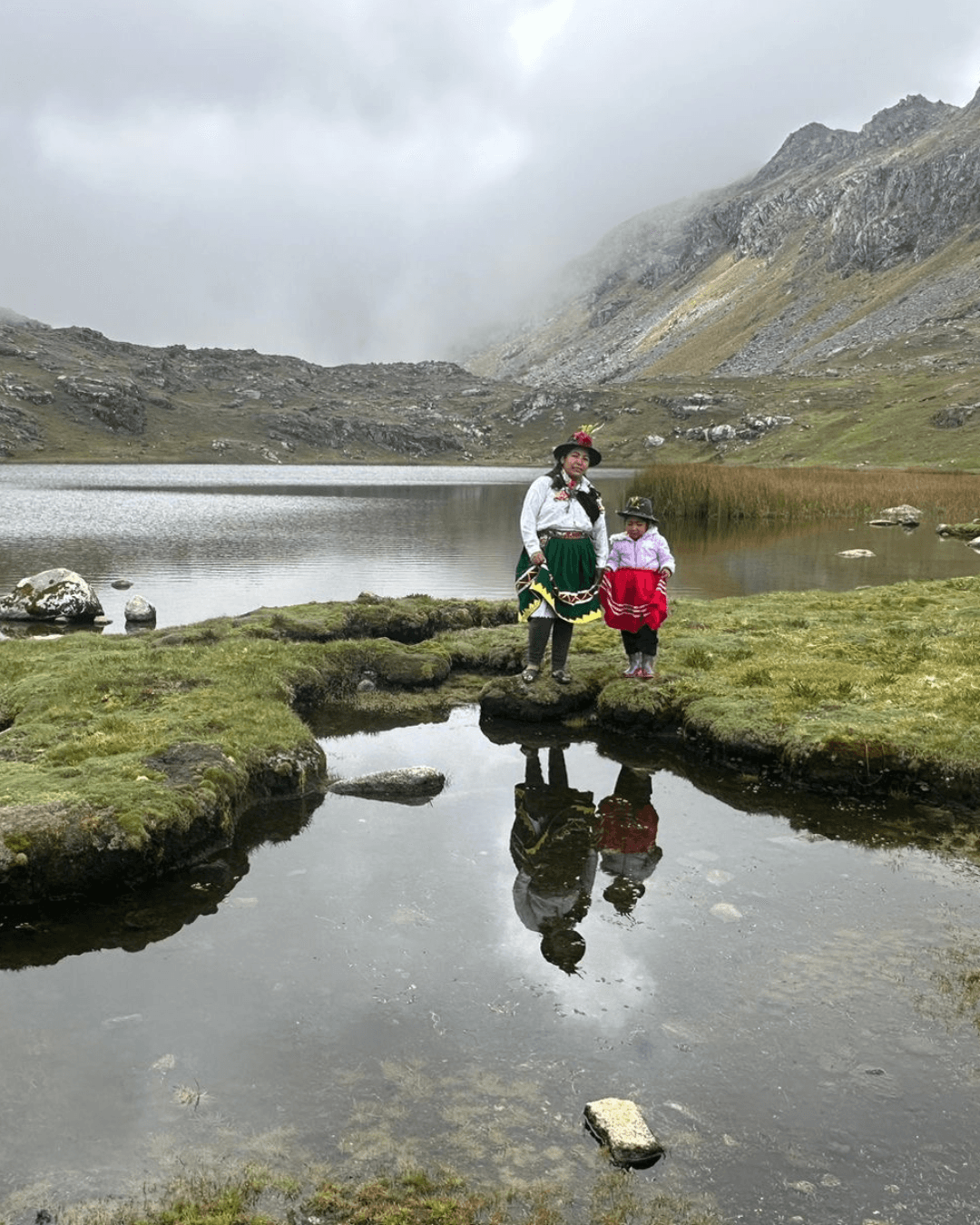
Mother and child in Abancay, Peru. Jan 2025. Credit: ICEA
What real partnership looks like
Over the past five years, Milkywire has been proud to support Acción Andina's work.
Their success reinforces something essential: meaningful conservation cannot be reduced to a single metric or intervention.
Planting trees matters. Protecting biodiversity matters. Strengthening community governance matters. Securing water resources matters. None of these outcomes exist independently. Healthy ecosystems depend on all of them working together.
That is why Milkywire believes in funding holistic nature initiatives that strengthen entire landscapes while supporting the people who steward them. Long-term resilience comes from investing in ecological systems, local institutions, and community leadership together.
Acción Andina's work demonstrates why this kind of integrated, long-term investment matters. As climate risks continue to grow, supporting locally led, landscape-scale restoration will become increasingly important for building resilience for both people and nature.
The funding gap
Conservation funding has traditionally been organized around short, project-based grants designed to deliver clearly measurable outputs within two or three years. A project may receive funding to plant a certain number of trees, restore a defined area, or complete a specific activity before the funding ends. While these approaches have delivered important results, they often leave little room to support the long-term stewardship, community capacity, and ecosystem management that determine whether restoration succeeds over decades.
Nature does not operate in funding cycles. Forests, wetlands and watersheds require continuous care long after a project has formally ended. A restored forest provides benefits for decades—regulating water, storing carbon, supporting biodiversity, and strengthening community resilience. Funding models should reflect that reality.
Initiatives like Acción Andina are already building new approaches through efforts such as Yaku Ñan ("Path of Water"), which aims to create longer-term financing for Andean restoration by combining philanthropic, public and other sources of capital.
These models recognize a simple truth: ecosystems are living infrastructure that require continuous care, not one-off investments.
Investing in the future we depend on
Every community, economy and society relies on healthy natural systems. Whether we depend on them through clean drinking water, food production, climate stability or livelihoods, nature underpins our collective well-being.
Nature has supported human prosperity for centuries. But the conditions that made that possible can no longer be taken for granted.
If we want resilient societies in the decades ahead, we need to invest in the ecosystems that make resilience possible.
That means supporting locally led initiatives, embracing the complexity of nature instead of simplifying it, and committing to the long-term stewardship that healthy landscapes require.
Because investing in nature isn't simply about protecting the environment. It's about protecting the foundations of our shared future.
The natural world has been subsidizing us for a very long time. It's time to invest back.